Gambling in Ancient Rome
Written in my final year at school for IB Latin HL. Same format as the Greek IA on the site: pick a research question, then translate and analyse a set of primary source passages in the original Latin to answer it. I asked what the status of gambling actually was in Rome between 200 BC and 400 AD, working from a tavern mural in Pompeii through Plautus, Suetonius, Seneca, Cicero and Ammianus Marcellinus.
Starting point

Taylor, Louise. “Sandro Tonali’s 10-month ban over betting complicated by Italy rehab trips.” The Guardian, 26 October 2023.
As a football fan, the news of Sandro Tonali’s ban over gambling caught my attention. Despite the legal consequences, many Newcastle fans spoke out in his support. That mix of reactions is what led me to the research question below.
Research question
What was the status of gambling in Rome between 200 BC and 400 AD?
Prediction
Modern restrictions on gambling show that the UK views it as something that can get out of hand, even if plenty of people enjoy it. I predicted that this same ambivalence would show up in ancient Rome: gambling as an inherently controversial topic, with genuinely differing views on it rather than one settled attitude.
Introduction
Gambling in ancient Rome involved betting on various games and spectator sports. It was a part of Roman life, and in this dossier I explore its status across seven sources, from 200 BC to 400 AD. I look first at sources that suggest gambling was a popular part of Roman life, then turn to others that criticise it. Much of the surviving evidence comes from wealthy male Roman elites, such as Cicero and Seneca, who aren’t necessarily representative of Roman society as a whole, but who do give a real insight into how their own social class viewed gambling.
Source 1: Mural Found in a Tavern in Pompeii · c. 50 AD
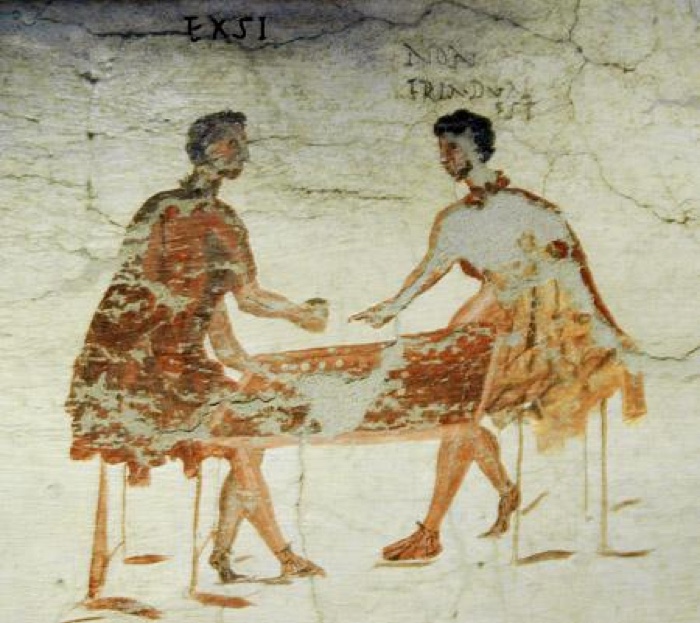
Gambling scene, tavern wall painting, Pompeii, 1st century AD.
Analysis: This mural was found in Pompeii, showing two men gambling at a tabula lusoria (gambling table); the figure on the left exclaims that he has won (EXSI). The mural was found in a taberna, a tavern serving the lower classes, which suggests gambling was a common enough recreational activity to be worth painting on the wall. This source supports the idea that gambling was a regular, visible part of civic Roman life, and a popular activity among ordinary citizens.
Source 2: Plautus, Miles Gloriosus, Act 2, Scene 2, Lines 1–10 · c. 205 BC
Latin
videritis alienum, ego vostra faciam latera lorea.
mi equidem iam arbitri vicini sunt, meae quid fiat domi,
ita per impluvium intro spectant. nunc adeo edico omnibus:
quemque a milite hoc videritis hominem in nostris tegulis,
extra unum Palaestrionem, huc deturbatote in viam.
quod ille gallinam aut columbam se sectari aut simiam
dicat, disperiistis ni usque ad mortem male mulcassitis.
atque adeo ut ne legi fraudem faciant aleariae,
adcuratote ut sine talis domi agitent convivium.
Translation
Analysis: Plautus’ comedy would have been performed at festivals attended by lower-class citizens. Here we see a reference to the lex talaria (legi…aleariae), which prohibited gambling. The law reflects the Roman state’s official view of gambling as a crime, but the fact that it was being broken raises questions about how seriously it was enforced. Either the state didn’t consider gambling worth backing with real punishments, or ordinary Romans thought the entertainment was worth the legal risk. Since this was a comedy, it would have exaggerated everyday Roman life to land the joke, and a joke about illegal gambling only works if the audience already recognises it. Despite the roughly 300-year gap, this source agrees with the mural: gambling was popular among ordinary Romans, whatever the law said.
Source 3: Suetonius, The Lives of the Twelve Caesars, Divus Augustus, Ch. 71 · c. 121 AD
Latin
Translation
Analysis: Suetonius wrote this to document the private, moral side of the emperors’ lives. Here he portrays Augustus as genuinely fond of gambling, evidenced by his reputation for playing even on “working days” (profestis diebus). Writing about a century after Augustus, Suetonius had every incentive to add colour and lean on gossip, so this may well be exaggerated. But even allowing for that, an emperor gambling openly, on a law he technically had the power to enforce, says something about how unremarkable the habit actually was.
Source 4: Seneca, Apocolocyntosis, Section 14 · c. 54 AD
Latin
Translation
Analysis: This is from Seneca’s satire on the recently-dead Emperor Claudius, who is condemned in the afterlife to rattle dice forever in a bottomless box. Seneca had personal reasons to dislike Claudius, who had exiled him in 49 BC, so this reads as much as a settling of scores as a comment on gambling itself. Even so, choosing gambling specifically as Claudius’ eternal punishment suggests Seneca saw it as a vice, and his audience of wealthy Roman elites likely shared that view. That doesn’t mean every Roman disliked gambling, but among the elite it could clearly be read as an inferior pastime.
Source 5: Cicero, Against Catiline, Ch. 10, §22–23 · 63 BC
Latin
Translation
Analysis: From Cicero’s speech against Catiline, this places gamblers at the bottom of Catiline’s circle, alongside adulterers, as “unclean and shameless” (impuri impudicique). This is a persuasive speech, delivered to appeal to the wealthy senatorial elite in front of him, so the language is doing rhetorical work as much as reporting a settled fact. Still, it tells us how that particular elite audience was expected to react to the word ‘gambler’: as an insult that would land.
Source 6: Cicero, Philippic II, Ch. 23, §56 · 44 BC
Latin
Translation
Analysis: From Cicero’s second Philippic, an attack on Mark Antony delivered in the senate, this passage notes Antony’s pardon of a man condemned for gambling, his own gambling partner. Combined with Source 5, this is Cicero using gambling to attach the lowest possible class association to Antony in front of the same senatorial audience. That gambling still worked as an insult 19 years after the Catiline speech shows some consistency in elite attitudes, but the fact that Antony pardoned his own gambling companion also points to a real gap between the elite’s public condemnation of gambling and their private practice of it.
Source 7: Ammianus Marcellinus, Rerum Gestarum, Book 14, Ch. 6, §25 · c. 380 AD
Latin
Translation
Analysis: Writing a history of the Roman Empire, Marcellinus describes gamblers here as belonging to the “greatest poverty” (paupertinae) and “lowest condition” (imae sortis), part of a wider chapter blaming the lower classes for Rome’s decline. His own noble background likely sharpens that contempt. What this source adds is a timeline: nearly 450 years after Cicero, elite writers are still reaching for gambling as shorthand for the low and disreputable, which strengthens the case that the elite disdain in Sources 5 and 6 wasn’t a one-off but a durable attitude.
Conclusion
Across these seven sources, gambling in Rome doesn’t settle into one clear status. Tavern-goers and at least one emperor enjoyed it openly, restrictions notwithstanding, while wealthy elites like Cicero, Seneca and Marcellinus treated it as something inferior and worth criticising. Gambling didn’t hold a single, agreed status across the Roman population. Different people, largely split along class lines, held genuinely different views of it.
Assessment of prediction
My prediction was largely right, but it missed the socioeconomic split. Sources 1 and 3 show ordinary Romans and at least one emperor enjoying gambling, while those higher up the social scale, Cicero and Marcellinus among them, regarded it as inferior. The lex talaria in Source 2 is also a near parallel to the law that got Sandro Tonali suspended in my starting point: a restriction that existed on paper well before it was consistently enforced in practice.
Works cited
- “Board Games, Dice Games and Gambling in Ancient Rome.” UNRV.com. Accessed 19 November 2023.
- “Caupona Wall Painting.” Food and Drink in the Ancient World. Accessed 19 November 2023.
- Cicero, M. Tullius. The Fourteen Orations Against Marcus Antonius (Philippics). Translated by C. D. Yonge. George Bell & Sons, 1903. Perseus Digital Library.
- Cicero, M. Tullius. Against Catiline. Translated by E. D. Yonge. Henry G. Bohn, 1856. Perseus Digital Library.
- Marcellinus, Ammianus. Rerum Gestarum. Translated by John C. Rolfe. Harvard University Press, 1935. Perseus Digital Library.
- Plautus, T. Maccius. Miles Gloriosus, or The Braggart Captain. Translated by Henry Thomas Riley. Bell and Sons, 1912. Perseus Digital Library.
- “Primary Legislation.” Gambling Commission. Accessed 21 November 2023.
- Seneca. Apocolocyntosis. William Heinemann, 1913. Perseus Digital Library.
- Taylor, Louise. “Sandro Tonali’s 10-month ban over betting complicated by Italy rehab trips.” The Guardian, 26 October 2023.
- Tranquillus, C. Suetonius. “The Lives of the Twelve Caesars – Life of Augustus.”