Tyranny in Athens
Written in my final year at school for IB Greek HL. The Individual Assessment is a source-based dossier: pick a research question, then translate and analyse a set of primary source passages in the original Greek to answer it. I looked at how tyrants and tyranny in Archaic and Classical Athens were actually received, working through Plato, Aristotle, Xenophon, Herodotus, Thucydides, and the inscription on a tyrannicide statue.
Starting point
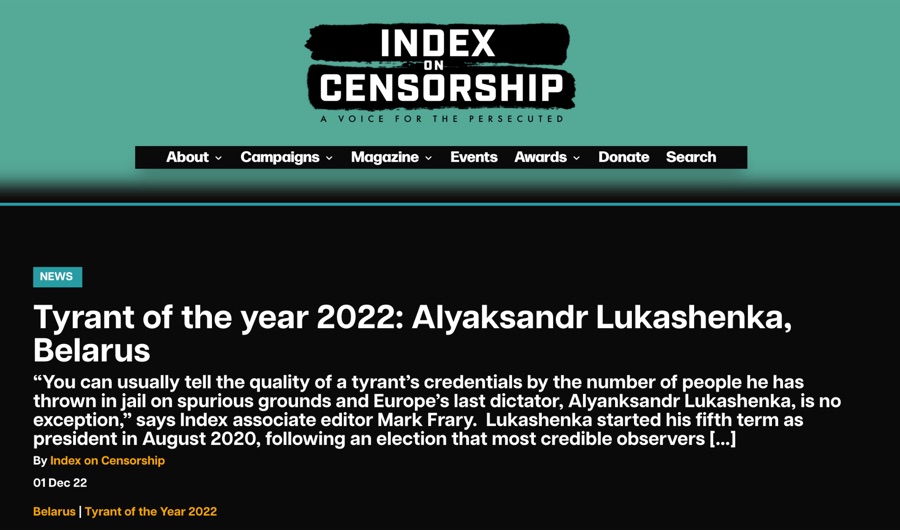
“Tyrant of the year 2022: Alyaksandr Lukashenka, Belarus.” Index on Censorship, 1 December 2022.
‘Index on Censorship’ voted Alyaksandr Lukashenka, the Belarusian leader, as 2022’s “Tyrant of the year”. The webpage’s contents satirise Lukashenka’s totalitarian regime, negatively characterising his ‘tyranny’. This example led me to investigate the research question below.
Research question
How were the tyrants of Athens in the 6th–4th centuries BC, and tyranny as a way of ruling, received?
Prediction
I predict that tyrants won’t have been received as negatively as they are today. I believe that many of our negative associations with tyrants stem from the negative connotations of the word ‘tyrant’. As these connotations weren’t necessarily associated with the ancient definition of ‘tyrant’, I predict that tyrants wouldn’t have been received as negatively.
Introduction
A tyrant today is an unfair and cruel ruler. This differs from the ancient definition of the word, as someone who gained power unconstitutionally. In this dossier, I shall explore if the attitudes towards tyrants in Athens in the 6th–4th centuries were as negative as the modern connotations of ‘tyrant’ suggest. I shall first investigate three philosophical texts which give a broad outline of attitudes towards tyrants before shifting my attention to historical accounts which offer a different insight into the Peisistratid tyrants, Peisistratus and his sons Hippias and Hipparchus.
Source 1: Plato, The Republic, Book 9, 577e–578c · c. 379 BCE
Greek
πενομένην.
καὶ ψυχὴν ἄρα τυραννικὴν πενιχρὰν καὶ ἄπληστον ἀνάγκη ἀεὶ εἶναι.
οὕτως, ἦ δ᾽ ὅς.
τί δέ; φόβου γέμειν ἆρ᾽ οὐκ ἀνάγκη τήν τε τοιαύτην πόλιν τόν τε τοιοῦτον ἄνδρα;
πολλή γε.
ὀδυρμούς τε καὶ στεναγμοὺς καὶ θρήνους καὶ ἀλγηδόνας οἴει ἔν τινι ἄλλῃ πλείους εὑρήσειν;
οὐδαμῶς.
ἐν ἀνδρὶ δὲ ἡγῇ τὰ τοιαῦτα ἐν ἄλλῳ τινὶ πλείω εἶναι ἢ ἐν τῷ μαινομένῳ ὑπὸ ἐπιθυμιῶν τε καὶ ἐρώτων τούτῳ τῷ τυραννικῷ;
πῶς γὰρ ἄν; ἔφη.
εἰς πάντα δὴ οἶμαι ταῦτά τε καὶ ἄλλα τοιαῦτα ἀποβλέψας τήν τε πόλιν τῶν πόλεων ἀθλιωτάτην ἔκρινας—
οὐκοῦν ὀρθῶς; ἔφη.
καὶ μάλα, ἦν δ᾽ ἐγώ. ἀλλὰ περὶ τοῦ ἀνδρὸς αὖ τοῦ τυραννικοῦ τί λέγεις εἰς ταὐτὰ ταῦτα ἀποβλέπων;
μακρῷ, ἔφη, ἀθλιώτατον εἶναι τῶν ἄλλων ἁπάντων.
Translation
Written approximately 130 years after the end of the Peisistratid tyranny, this passage is from Book 9 of Plato’s Republic, where Plato justifies the tyrannical life as the worst. Plato compares the tyrannised city (τυραννουμένην πόλιν) with the tyrant soul (ψυχὴν ἄρα τυραννικὴν). Both are poor (πενομένην) and maddened by desires and passions (ὑπὸ ἐπιθυμιῶν τε καὶ ἐρώτων). Plato’s criticisms stem from the tyrant’s inability to satiate his desires and the ensuing poverty that follows. Plato would have written this text in light of the tyrants of the previous centuries, meaning Plato may have based his ideas on their actions. Importantly, the Republic is a philosophical text which prompts the reader to contend the ideas mentioned, meaning that any ideas were Plato’s own and not guaranteed fact. Thus, this opinion gives a flavour of Plato’s negative attitudes towards tyranny.
Source 2: Aristotle, The Nicomachean Ethics, Book 8, Ch. 10, §2 · c. 340 BCE
Greek
Translation
Another philosophical work, the Nicomachean Ethics, was written nearly 200 years after the Peisistratids. Here, Aristotle defines tyranny as the “worst”, arguing that tyrants are greedy and only pursue what is in their good. Aristotle’s grounds for his negative attitudes towards tyrants are similar to his teacher’s in the previous source. Both sources condemn the greedy desires typical to all tyrants, suggesting that this makes them immoral.
Source 3: Xenophon, Hiero, Ch. 7, §11–13 · c. 360 BCE
Greek
Translation
From Xenophon’s Hiero, his philosophical dialogue on tyrants, in this extract, the poet Simonides describes tyranny as “vile”, with Hiero arguing that tyrants would benefit from killing themselves since they cannot otherwise repay their crimes of robbing and imprisoning others. Like the previous two sources, this source shows the injustices of tyranny. The tyrant is so unjust that his best action would be to kill himself. Xenophon develops on Aristotle and Plato, pointing out that tyrants benefit only by wronging others, thus arguing that tyrants bring no benefit. These first three sources provide a broadly negative outlook on tyranny, suggesting that it is an inferior way of ruling and that the tyrant is an unhappy and greedy character.
Source 4: Aristotle, Athenian Constitution, Ch. 16, §7 · c. 350 BCE
Greek
Translation
This passage from the Athenian Constitution discusses the Athenian citizens’ attitudes towards tyrant Peisistratus’ second period of power. Whether Aristotle wrote the Athenian Constitution is unclear, meaning it’s unclear if these were his views. However, it still represents an attitude towards tyrants in Athens. Peisistratus’ reign is described as a “Golden Age of Cronos”. This might be because of his benevolence in “not disturbing the people in any matters” or because the reign of his sons was “much harsher”. Either way, the optimistic view towards Peisistratus contrasts Aristotle’s previous negative outlook on tyrants in Source 2. This contradiction may be due to the source’s unreliability, but it may suggest that Aristotle found Peisistratus’ goodwill to be an exception to his broad conception that tyranny was the worst of all regimes.
Source 5: Herodotus, The Histories, Book 1, Ch. 59, §4–6 · c. 425 BCE
Greek
Translation
From Herodotus’ Histories, this source describes Peisistratus’ attempts at gaining power a second time. Peisistratus’ persuasive powers helped him secure power and rule “fairly and well”. However, Herodotus wrote nearly 150 years after Peisistratus, meaning any specific information may have been distorted. This doesn’t necessarily diminish this source’s value, as it shows that the broad consensus that Peisistratus was a popular tyrant with persuasive skills and a fair regime still existed 150 years after his rule, when democracy was at its height.
Source 6: Thucydides, The Peloponnesian War, Book 6, Ch. 54, §5 · c. 420 BCE
Greek
Translation
This source recounts the tyranny of Peisistratus’ sons. Thucydides positively depicts their reign’s (527–510 BCE) beginning, claiming it wasn’t “grievous” to the masses as it cultivated both “wisdom and virtue”. This source shows the positive similarities between the tyrannies of Peisistratus and his sons, both seeming popular with the masses. However, despite Thucydides’ intentions of portraying events as they truly happened, this source may be unreliable since it was written nearly 100 years after the Peisistratids.
Source 7: Roman copy of the lost tyrannicides statue, with its inscription
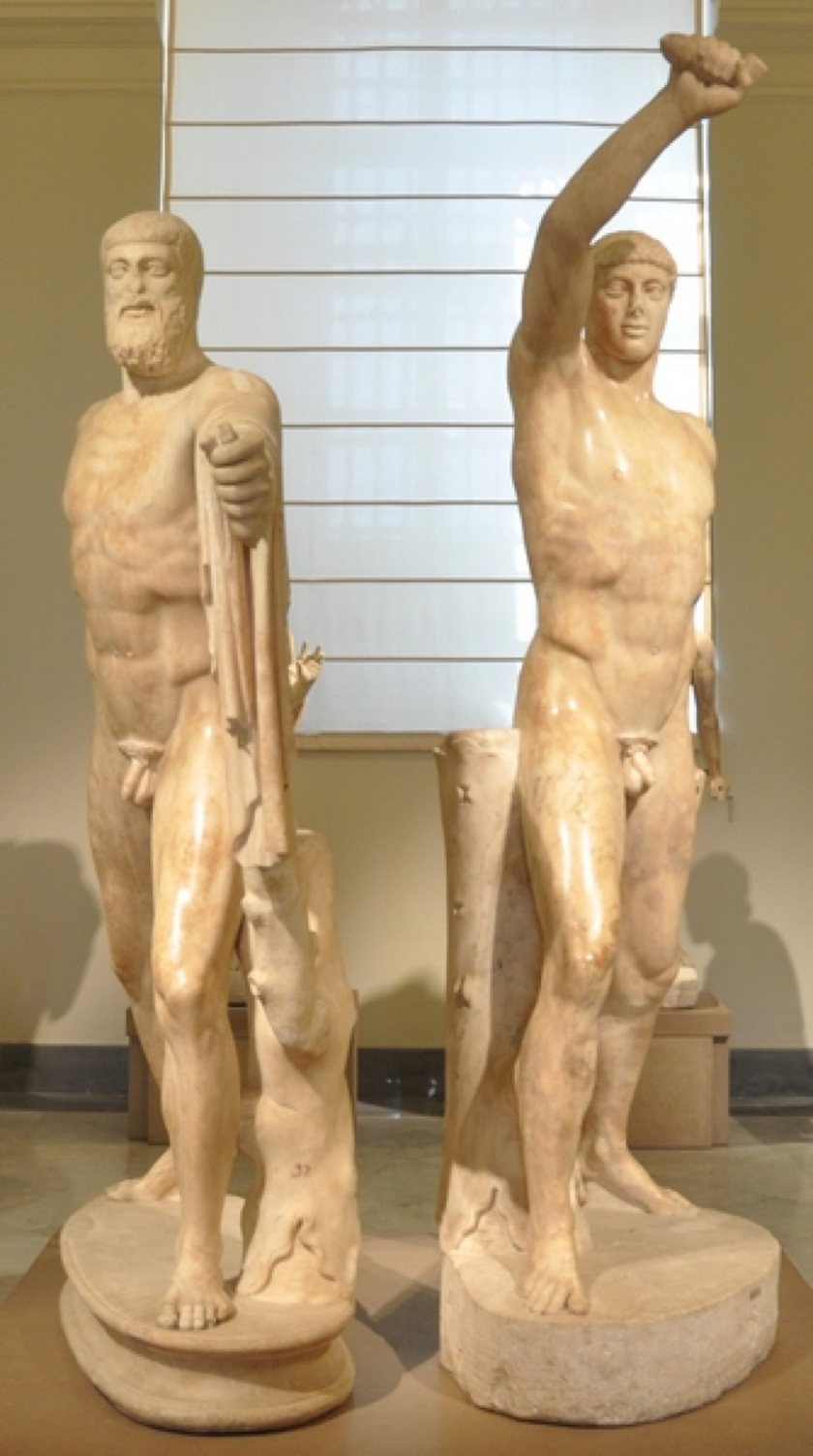
Roman marble copy of the tyrannicides group of Harmodius and Aristogeiton. Surviving Roman copies are generally associated with the bronze group by Kritios and Nesiotes of 477/476 BCE, itself a replacement for the earlier group by Antenor; which original any given copy derives from is not settled.
Greek
Translation
This is a copy of a statue, originally in the Athenian agora, celebrating Harmodius and Aristogeiton slaying Hipparchus (514 BCE), one of Peisistratus’ sons. The original was stolen, but copies survived. The statue celebrates Harmodius and Aristogeiton as tyrannicides, expressing their powerful stances and raised arms. Importantly, Harmodius and Aristogeiton didn’t kill Hipparchus because he was a tyrant but because he was involved in a messy love affair. However, the statue’s position in the agora is noteworthy, as it was a public display everyone saw daily. This suggests that Harmodius and Aristogeiton’s actions were so celebrated that they became part of everyday life. This is also evident in Simonides’ inscription: “a great light shone upon Athens”. Ultimately, the statue reflects the attitudes of 4th-century Athenians who wished to celebrate these tyrannicides’ victory over tyranny in their agora.
Source 8: Thucydides, The Peloponnesian War, Book 6, Ch. 59, §2 · c. 420 BCE
Greek
Translation
Also from Thucydides, this source helps contrast the beginning and end of Peisistratus’ sons’ tyranny. Hipparchus had been murdered, with Hippias now the sole ruler. Thucydides describes Hippias’ cruel response to his brother’s murder and his having put citizens to death, which is at odds with the benevolent behaviours we see in Source 6. This source shows the contrasting effects that Hippias’ tyrannical regime had. While Hippias’ rule didn’t initially seem adverse to the people, we can see the eventual cruelty he inflicted upon his subjects. This source, alongside Source 6, suggests that tyrannies weren’t inherently good or bad. Instead, various factors may have led to particular tyrants behaving in multiple ways, independently of any negative attitudes surrounding tyrannies.
Conclusion
In conclusion, there are varying views about tyrannies. Philosophers such as Xenophon and Plato give an unfavourable account of tyrants, arguing that they are greedy and wrong others. However, in particular instances, such as with Peisistratus, the good actions of tyrants mean that they transcend the negative baseline the philosophers offer. Historians writing during Athens’ period of democracy, Thucydides and Herodotus, still had positive things to say about Peisistratus. This suggests that although tyrannies may have been viewed negatively, Peisistratus, in particular, wasn’t. However, Source 7 shows the negative outlook on tyrannies that 4th-century Athenians may have had, as they chose to celebrate two tyrannicides. Generally, while the first three sources offer a broad dismissal of tyrants, the others suggest that there was no singular view on tyrants and that the individual actions of tyrants would have moulded any perspective.
Assessment of prediction
My prediction failed to account for the fact that there was still a broadly negative conception of tyranny, as seen by the first three sources. Source 7 also disproves my theory, although Sources 4, 5 and 6 show that particular tyrants (rather than the broad idea of tyranny) were received more positively, which is at odds with the starting source that negatively characterised tyrants.
Works cited
- Cottam, Charlie, et al. OCR Ancient History AS and a Level Component 1: Greece. Edited by James Renshaw, Bloomsbury Publishing Plc, 2017.
- Dent, J. M. “Thucydides, The Peloponnesian War.” Perseus Digital Library. Accessed 3 March 2024.
- Edmonds, J. M. “Elegy and Iambus, Volume I.” Perseus Digital Library. Accessed 3 March 2024.
- Godley, A. D. “Herodotus, The Histories.” Perseus Digital Library. Accessed 3 March 2024.
- Marchant, E. C. “Xenophon, Hiero.” Perseus Digital Library. Accessed 3 March 2024.
- Rackham, H. “Aristotle, Athenian Constitution.” Perseus Digital Library. Accessed 3 March 2024.
- Rackham, H. “Aristotle, Nicomachean Ethics.” Perseus Digital Library. Accessed 3 March 2024.
- Shorey, Paul. “Plato, Republic.” Perseus Digital Library. Accessed 3 March 2024.
- “The tyrannicides and the coinage.” Classical Numismatics Discussion. Accessed 3 March 2024.
- “Tyrant | English meaning.” Cambridge Dictionary. Accessed 3 March 2024.
- “Tyrant of the year 2022: Alyaksandr Lukashenka, Belarus.” Index on Censorship, 1 December 2022. Accessed 3 March 2024.